
Sarcopenia in women manifests as a progressive loss of skeletal muscle mass and strength, often accelerated by menopause. Key symptoms include a noticeable reduction in grip strength, slower walking speeds, difficulty rising from a chair without support, and increased fatigue during daily activities. Early detection allows for reversal through targeted resistance training and protein optimization.
What is Sarcopenia? Understanding Muscle Loss in Women
Sarcopenia is often mistakenly viewed as an inevitable part of aging, a slow decline that every senior must accept. However, in the realm of medically informed fitness and lifestyle performance, we define sarcopenia as a treatable condition characterized by the degenerative loss of skeletal muscle mass (quality), power, and strength. While it affects both genders, the trajectory for women is distinct and often more precipitous due to hormonal shifts.
For active agers in Auckland and beyond, the diagnosis of sarcopenia is not just about aesthetics or “looking toned.” It is a functional crisis. Muscle tissue is the primary reservoir for amino acids and plays a critical role in glucose disposal (blood sugar management). When muscle mass declines, the body’s metabolic rate drops, insulin resistance often increases, and the risk of falls skyrockets. Understanding the pathology of this condition is the first step toward reclaiming physical independence.

Key Symptoms of Sarcopenia in Women
Identifying the symptoms of sarcopenia in women early is crucial for effective intervention. Unlike a sudden injury, sarcopenia creeps in slowly, often masked by the assumption that “slowing down” is normal. However, clinical indicators are specific and measurable.
1. Diminished Grip Strength
One of the most reliable clinical biomarkers for overall vitality and muscle status is grip strength. Women experiencing sarcopenia often find it increasingly difficult to open jars, carry grocery bags, or hold onto railings firmly. If you find your hands fatiguing rapidly during tasks that used to be effortless, this is a primary red flag for systemic muscle weakness.
2. Reduced Gait Speed (Walking Pace)
Walking speed is often referred to as the “sixth vital sign” in geriatrics. A symptom of advancing sarcopenia is an involuntary reduction in walking pace. You may notice that keeping up with friends on a walk around the local park or navigating a crosswalk before the light changes requires conscious effort. This slows down because the fast-twitch muscle fibers (Type II fibers), responsible for power and speed, are the first to atrophy.
3. Difficulty with Sit-to-Stand Transitions
The quadriceps and glutes are the largest muscle groups in the body and are essential for mobility. A hallmark symptom is the need to use armrests or momentum to push yourself out of a chair. If you cannot stand up from a seated position without using your hands for support, it indicates significant atrophy in the lower body prime movers.
4. Unexplained Weight Loss or “Skinny Fat” Composition
Sarcopenia does not always look like frailty. Sarcopenic obesity is a condition where muscle mass decreases while fat mass remains the same or increases. A woman might weigh the same as she did ten years ago, but her body composition has shifted drastically—muscle has been replaced by adipose tissue. This often manifests as softer limbs, a larger waist circumference, and a lack of muscle definition, even if the scale hasn’t moved.
The Hormonal Link: Estrogen and Muscle Wasting
Why is the focus so heavily on women? The answer lies in menopause. Estrogen is not just a reproductive hormone; it is anabolic, meaning it helps maintain muscle mass and bone density. When estrogen levels plummet during perimenopause and menopause, the protective effect on muscle tissue vanishes.
Without the anabolic stimulus of estrogen, women become more susceptible to the catabolic (breakdown) effects of aging. Inflammation levels (IL-6 and TNF-alpha) tend to rise, which further accelerates muscle protein breakdown. This is why a fitness routine that worked in your 30s often fails to produce results in your 60s. The hormonal environment has changed, and therefore, the training stimulus must change to compensate.

The Myth That Seniors Shouldn’t Lift Heavy
There is a pervasive and dangerous myth in the fitness industry that as you age, you should switch to light pink dumbbells and high repetitions to “tone” without injury. From a physiological standpoint, this is the exact opposite of what is required to treat symptoms of sarcopenia in women.
Understanding Motor Unit Recruitment
Sarcopenia predominantly attacks Type II (fast-twitch) muscle fibers. These are the fibers responsible for strength and power. Low-weight, high-repetition exercise (like walking or light aerobics) only utilizes Type I (slow-twitch) fibers. To activate and preserve the Type II fibers that are dying off, you must impose a demand that requires high force production.
Lifting “heavy” is relative to the individual’s capacity, but the principle of Progressive Overload remains non-negotiable. If the resistance does not challenge the muscle near the point of fatigue, the body has no biological incentive to synthesize new muscle protein. Heavy resistance training triggers the release of mechanotransducers that signal the body to retain muscle mass despite the aging process.
The Critical Link Between Muscle and Bone Density
Sarcopenia rarely travels alone; it is frequently accompanied by osteopenia or osteoporosis. This combination is medically termed “Osteosarcopenia,” a condition that significantly increases the risk of fractures, disability, and loss of independence.
The relationship between muscle and bone is governed by Wolff’s Law, which states that bones adapt to the loads under which they are placed. When muscles contract with high force against resistance, they pull on the tendons, which in turn pull on the bone. This mechanical stress stimulates osteoblasts (bone-building cells) to lay down new mineral matrix.
Therefore, treating sarcopenia with strength training is a two-for-one medical intervention. By increasing muscle strength, you are simultaneously fortifying the skeletal structure. Activities that do not load the spine and hips (like swimming or cycling) are excellent for cardiovascular health but do very little to arrest the progression of bone density loss in post-menopausal women.
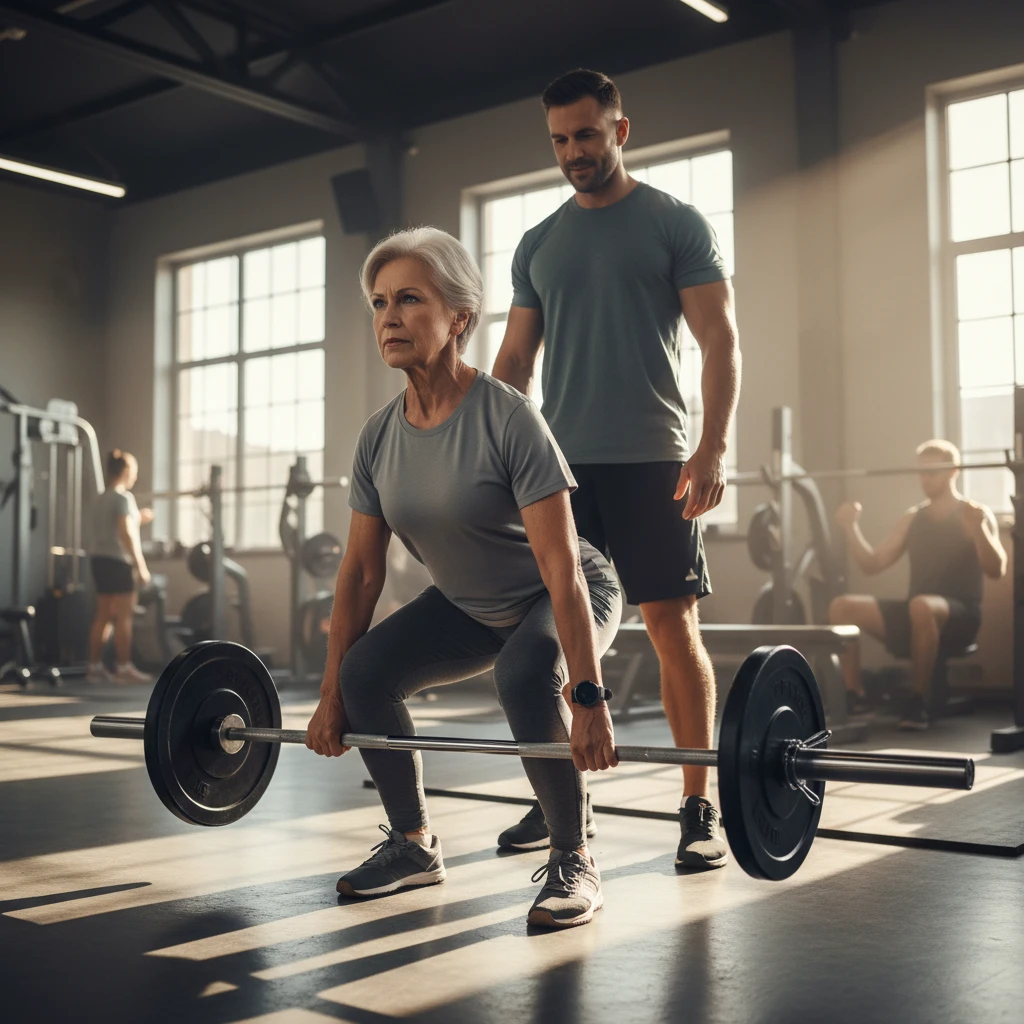
Private PT vs. F45: Why Supervised Strength is Safer
In the pursuit of fitness, many Auckland seniors are drawn to group fitness models like F45, CrossFit, or high-intensity interval training (HIIT) boot camps. While the community aspect is positive, the programming methodology often presents unnecessary risks for women managing sarcopenia.
The Problem with Speed and Fatigue
Most commercial group classes prioritize metabolic conditioning—getting your heart rate up and making you sweat through high-speed, high-repetition movements with short rest periods. For a senior population, this is problematic for two reasons:
- Form Degradation: As fatigue sets in, technique falters. In a class of 30 people, a coach cannot correct every hip hinge or knee alignment. Poor form under fatigue is the primary mechanism of injury.
- Insufficient Load: To move fast, you must use light weights. As discussed, light weights do not adequately stimulate the Type II fibers needed to reverse sarcopenia.
The Value of Medically Informed Private Training
Private Personal Training, particularly in a medically informed context, prioritizes Time Under Tension and controlled eccentrics over heart rate. In a private setting, a coach can ensure that a client is lifting a load heavy enough to stimulate adaptation but with perfect biomechanics.
Furthermore, treating sarcopenia requires longer rest periods (2–3 minutes) between sets to allow the nervous system to recover, enabling maximum force output on the next set. Group classes rarely allow for this necessary recovery. For the aging woman, exercise should be treated as a prescription: the dose (weight), frequency, and formulation (exercise selection) must be tailored to the individual’s orthopedic history and capability.
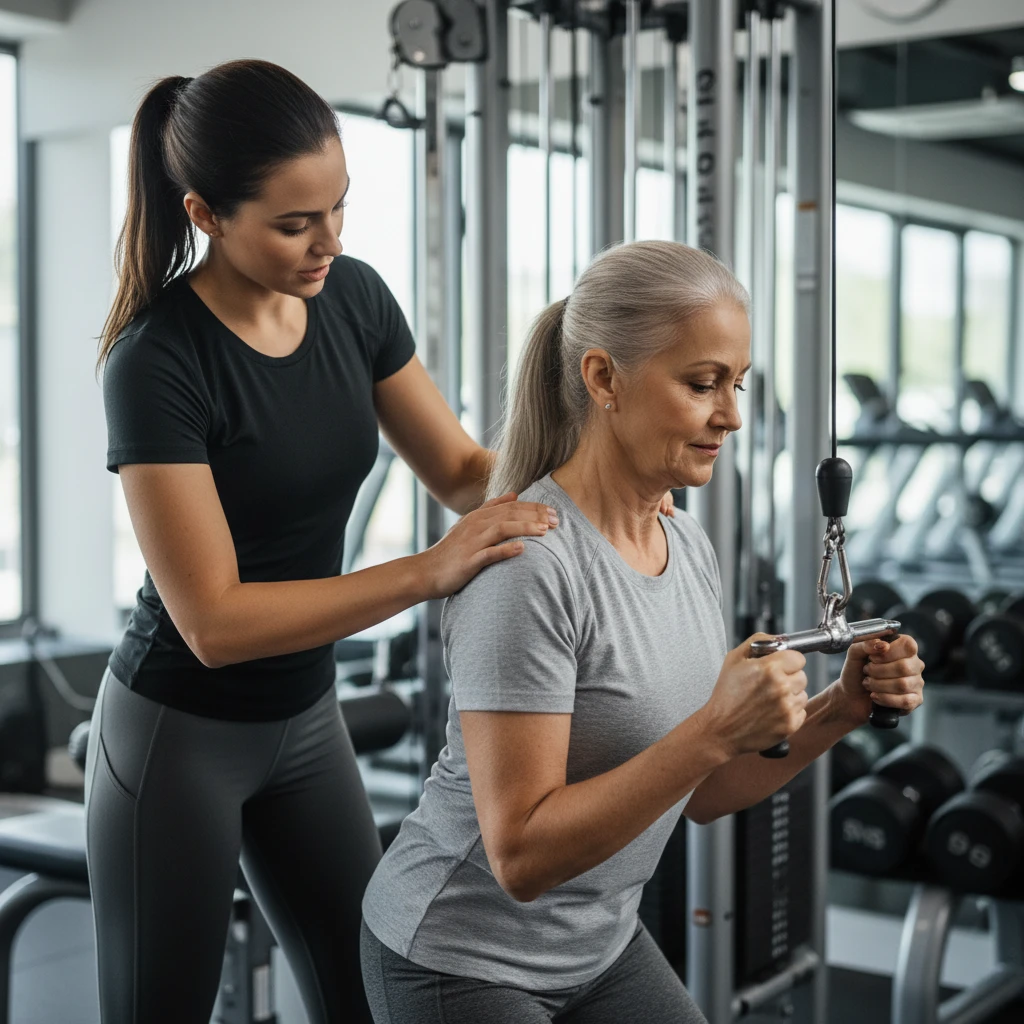
Actionable Steps to Reversing Muscle Loss
If you recognize the symptoms of sarcopenia, the situation is not hopeless. Muscle tissue retains high plasticity (the ability to change) well into the 90s. Here is the strategic approach to reversal:
1. Prioritize Protein Intake
Anabolic resistance is a phenomenon where older adults require more protein than younger adults to stimulate the same amount of muscle synthesis. Women over 60 should aim for 1.6 to 2.0 grams of protein per kilogram of body weight. Specifically, the amino acid Leucine is critical for triggering the muscle-building switch.
2. Strength Train 2-3 Times Per Week
Engage in a full-body resistance training program. Focus on compound movements that utilize multiple joints: squats (to a box/chair), hinges (deadlifts), pushes (overhead or chest press), and pulls (rows). Aim for 3 sets of 8–12 repetitions where the last two reps feel challenging.
3. Creatine Monohydrate Supplementation
Often associated with bodybuilders, creatine is one of the most researched supplements for neuroprotection and muscle preservation in the elderly. It helps improve cellular hydration and energy production, allowing for more effective training sessions.
4. Consult a Specialist
Before beginning, especially if you have existing conditions, consult with a medically informed fitness professional who understands the geriatric physiology. They can design a program that works around arthritis, joint replacements, or cardiovascular limitations.
People Also Ask
At what age does sarcopenia start in women?
Muscle mass naturally begins to decline as early as age 30, with a loss of roughly 3-5% per decade. However, this process accelerates significantly after age 50 and the onset of menopause due to the drop in estrogen levels. Without intervention, the rate of loss can increase dramatically in the 60s and 70s.
Can sarcopenia be reversed in women?
Yes, sarcopenia can be partially reversed or significantly slowed. Even women in their 80s and 90s have shown the ability to build muscle mass and increase strength through high-intensity resistance training and adequate protein intake. It is never too late to start the process of rebuilding.
What is the best vitamin for sarcopenia?
Vitamin D is crucial for muscle function and bone health. Low levels of Vitamin D are consistently linked to reduced muscle strength and increased fall risk. While not a vitamin, Creatine Monohydrate and Omega-3 fatty acids are also highly recommended supplements for managing muscle health in seniors.
How is sarcopenia diagnosed?
Medical professionals diagnose sarcopenia using a combination of tests: DEXA scans to measure lean muscle mass, handgrip dynamometers to test grip strength, and gait speed tests. A grip strength of less than 16kg for women is often used as a clinical threshold for diagnosis.
Is walking enough to prevent sarcopenia?
No, walking is generally insufficient to prevent sarcopenia. While walking is excellent for cardiovascular health and mobility, it does not provide enough resistance to stimulate Type II muscle fiber growth. To combat muscle loss, you must engage in resistance training that challenges the muscles beyond their comfortable capacity.
What foods help fight sarcopenia?
Foods high in leucine-rich protein are best. This includes eggs, lean meats (chicken, beef), fish, Greek yogurt, and whey protein. For plant-based eaters, combining sources like lentils, quinoa, and tofu is essential to get a complete amino acid profile necessary for muscle repair.


